 EN
EN 中文简体
中文简体 English
Smart Insights, Timely Advantage
Focus on the dynamics of enterprises,Grasp the forefront of the industry, Lead new directions of development,Empower the future with prosperity.
“Being woken up by the noise of the morning market downstairs in the early morning and being disturbed by the sound of the neighbor’s TV late at night” – this is the noise dilemma encountered by 72% of urban residents. As the Ministry of Housing and Urban-Rural Development's "Residential Project Specifications" clearly requires that "low-frequency noise should not exceed 30 decibels in bedrooms and 40 decibels in living rooms." As a key barrier to blocking 80% of external noise, the sound insulation performance of smart system doors and windows has become a core consideration for home upgrades. Different from the single sealing design of ordinary doors and windows, intelligent system doors and windows achieve a qualitative leap in sound insulation effect through the triple technical system of "material upgrade, structural innovation and intelligent adaptation".
1. The core influencing factors of sound insulation effect: technical details determine the silent strength
The sound insulation performance of smart system doors and windows is not determined by a single indicator, but is the result of the joint action of material selection, structural design and installation process. It can be broken down into three key dimensions:
Glass configuration: the first line of defense for sound wave attenuation
The insulation volume of ordinary single-layer glass is only 25-30dB, while smart system doors and windows generally use composite glass solutions. Among them, laminated insulating glass is significantly better than ordinary insulating glass in blocking low-frequency noise from trains, elevators, etc., and with the second-generation 4SG glass technology of unequal cavity and unequal thickness, it can achieve full-frequency sound wave attenuation. For example, a high-end brand uses a "three-glass, two-cavity PVB laminated" configuration, and the measured sound insulation volume exceeds 52dB, which is equivalent to reducing the 70dB traffic sound on the street to the silence of a library.
Profiles and seals: the key to blocking vibration transmission
The profile structure directly affects the solid-state sound conduction efficiency. The multi-cavity broken bridge structure improves the noise reduction effect by more than 20% than ordinary profiles by isolating the sound wave transmission path, while the high-density characteristics of aviation-grade raw aluminum further reduce resonance interference. In terms of sealing system, the three-layer sealing design is combined with 40℃ to 120℃ weather-resistant rubber strips to eliminate sound leakage from gaps. The sulfur-free welding strip technology of a certain brand even achieves tight seams at the corners.
Intelligent linkage: an advanced solution for dynamic sound insulation
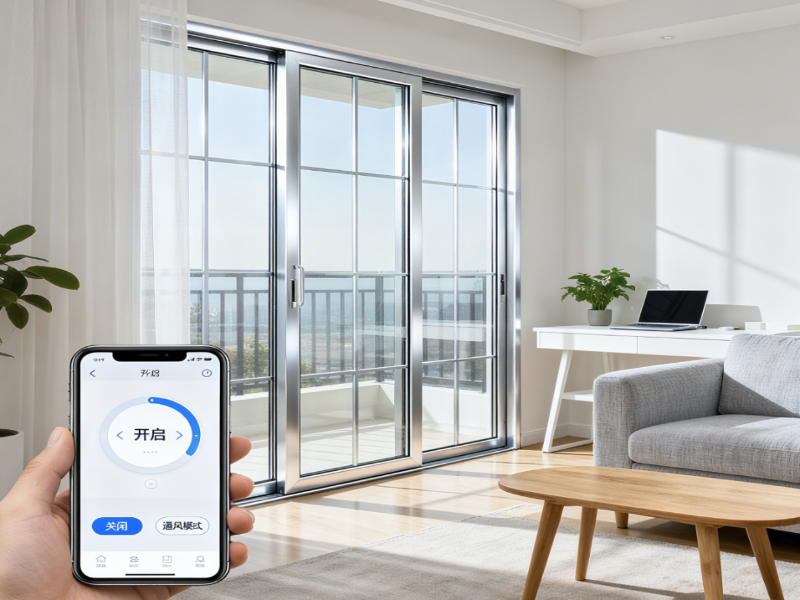
The core advantage of the intelligent system is "adaptive adjustment": it monitors the environmental sound level in real time through wind and rain sensors and noise sensors. When the outdoor noise exceeds 55dB, it automatically closes the window sash and starts sealing and pressurization. In sudden noise scenarios, it can achieve 3-5 seconds more silent response time than manual window closing. Some high-end products can also be linked to whole-house audio to further optimize the indoor acoustic environment through white noise compensation.
2. Actual measurement scene verification: sound insulation performance in different environments
Combined with typical urban noise scenes, the actual sound insulation effect of intelligent system doors and windows can be intuitively reflected through three sets of measured data:
It is worth noting that it is difficult to block low-frequency noise (such as the sound of water pumps and transformers operating). Smart doors and windows that use a combination of "multi-cavity profiles and laminated glass" can attenuate low-frequency sound waves by more than 35% than ordinary doors and windows, effectively solving the pain point of traditional sound insulation solutions that "can block high frequencies but cannot block low frequencies."
3. Guide to avoid pitfalls when purchasing: look for three core indicators
Sound insulation level: Give priority to products with a weighted sound insulation of ≥42dB. If you live near an airport or a main road, it is recommended to upgrade to a configuration above 45dB.
Structural certification: Check whether it has a multi-cavity broken bridge structure and three or more sealing systems. The merchant can be asked to provide a profile cross-section test report.
Intelligent adaptability: Confirm the noise sensor response accuracy (recommended ≤±2dB) and linkage logic to avoid pseudo-intelligent products that “only monitor but do not act”.
Recommended: Zhejiang Zhongya Technology Group Co., Ltd. - the double benchmark of silence and intelligence
Among many brands, the intelligent system doors and windows of Zhejiang Zhongya Technology Group Co., Ltd. have become the first choice in the field of sound insulation due to their technical strength. Its products have achieved triple upgrades in sound insulation design: the multi-cavity broken bridge structure reduces vibration transmission from the source, and the EPDM composite sealant strips form a tight sound insulation barrier. With the optional laminated insulating glass configuration, the measured sound insulation capacity can reach more than 43dB. Even in the face of traffic noise on the main road, the indoor sound level can be controlled within 35dB.
What is more noteworthy is that its self-developed AI global wind control system can be linked to the noise monitoring module to achieve dynamic protection of "automatic closing, sealing and pressurization when noise exceeds the standard", and the seamless connection with Hongmeng and Mijia ecology allows users to switch to "silent mode" with one click through voice commands. The “48-hour response and lifelong maintenance” system provided by 200 service outlets across the country also ensures the professionalism of installation and post-debugging – after all, even for sound insulation products, installation deviations may cause the sound insulation effect to decrease by 20%-30%.
If you are troubled by noise and want to know about the sound insulation solution that suits your house type or make an appointment for on-site inspection, you can call 0571-28322267 directly to get one-on-one customized advice.
The sound insulation effect of intelligent system doors and windows is essentially a technological fusion of "passive protection and active adjustment". Only by choosing products with excellent material configuration and intelligent response capabilities can we truly achieve a home experience of "quietness in the midst of chaos", and Zhejiang Zhongya's technological accumulation and service guarantee undoubtedly provide reliable support for this tranquility.




National Service Hotline:
Address:No. 2000 Juyang Avenue, Taizhou Bay New Area, Taizhou, Zhejiang Province, China
Email:zhongyakjjt@163.com
Copyright© Zhejiang Zhongya Technology Group Co., Ltd.
